CALL: 985-200-4333
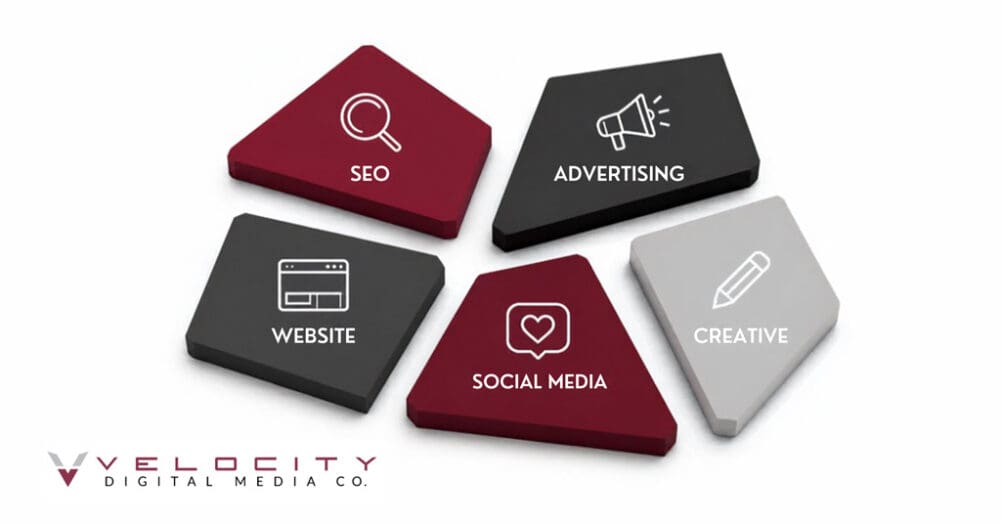
The Hidden Cost of a Fragmented Marketing Strategy: Why Your SEO, Advertising, Website, Social Media and Creative Should Work Together
For years, businesses have been told they need a website company, an SEO company, a social media manager, a media buyer, a video production company, a graphic designer and an advertising agency. The result? A lot of vendors. A lot of meetings. A lot of emails. And sometimes, a marketing strategy that doesn’t feel like a strategy at all. Instead, it feels like a collection of separate pieces. That is the hidden cost of a fragmented marketing strategy. When your website is being managed by one company, SEO by another, paid advertising by another, social media by someone else and creative production by another vendor, every individual piece may be doing its job—but the pieces may not be working together. Integrated marketing changes that. At Velocity Agency, we believe your marketing should function as one connected system, with strategy, creative, media, digital marketing, web development, content and production working toward the same business objectives.
What Is a Fragmented Marketing Strategy?
A fragmented marketing strategy happens when different marketing functions are handled independently, often by multiple vendors or departments that don’t have a shared strategy. For example:
- One company manages your SEO.
- Another manages Google Ads.
- A freelancer handles social media.
- A web developer maintains your website.
- A production company creates your commercials.
- A media company handles TV and radio.
- A graphic designer creates your promotional materials.
- Your internal team tries to coordinate everyone.
Individually, these providers may be excellent. The problem is coordination. Who makes sure the SEO strategy supports the paid search strategy? Who makes sure the website experience matches the advertising campaign? Who makes sure the video content created for television can also be used across social media, YouTube and digital advertising? Who makes sure the creative message is consistent across your website, billboards, social media, email, radio and paid media? And perhaps most importantly: Who is looking at the entire customer journey?
Marketing Works Better When the Pieces Connect
Modern customers rarely interact with a business through a single channel. A potential customer might see a social media video, search Google for the company, read reviews, visit the website, watch another video, see a retargeting ad and finally contact the business. That means every interaction contributes to the customer’s perception of the brand. If those interactions feel disconnected, opportunities can be lost. If they reinforce one another, your marketing becomes more connected and easier to manage. Research published by Think with Google on the customer journey describes the journey through stages including awareness, consideration, action and loyalty, reinforcing the importance of understanding how different marketing touchpoints contribute throughout the customer relationship. For businesses, that means marketing shouldn’t necessarily be organized around individual channels. It should be organized around what you’re trying to accomplish and how customers move toward that goal.
Your Website Should Not Exist in a Vacuum
Your website is often the center of your digital marketing ecosystem. Yet businesses sometimes treat website development as a one-time project: Build the website. Launch it. Move on. Today’s websites need to do much more. Your website needs to support:
- Search engine optimization
- Paid advertising
- Mobile users
- Lead generation
- E-commerce
- Content marketing
- Social media traffic
- Brand credibility
- Analytics and conversion tracking
- AI-powered search discovery
It also needs to communicate the same brand message customers encounter everywhere else. Velocity’s web development and digital marketing services are designed to work as part of a larger marketing strategy rather than as isolated projects. That distinction matters. A beautiful website that nobody can find isn’t enough. A highly optimized website with poor branding isn’t enough. A website that generates traffic but makes it difficult for visitors to take the next step isn’t enough. The website has to work with everything around it. Google’s SEO Starter Guide emphasizes that SEO is about helping search engines understand content while helping users find and understand a website. That makes the relationship between a website’s structure, content and broader marketing strategy increasingly important.
SEO and Paid Advertising Should Inform Each Other
SEO and paid advertising are often treated as competing strategies. They don’t have to be. Organic search can reveal what customers are searching for, what questions they have and which topics deserve more attention. Paid search can provide immediate visibility for valuable searches while longer-term organic strategies develop. Together, they can provide a more complete picture of search behavior. Velocity’s SEO services and digital marketing capabilities can be integrated with paid media, content, website development and other campaign components. That creates an opportunity to take information learned from one channel and apply it to another. Instead of asking: “Should we do SEO or PPC?” The better question is: “How should SEO and PPC work together to support our business goals?” Google also provides Search Console, which gives businesses and website owners information about how their sites perform in Google Search. That data can help marketers understand how people discover a website and identify opportunities for improvement.
Creative Should Be Part of the Strategy, not an Afterthought
Creative is sometimes brought into a campaign after the strategy has already been determined. But creative can, and should be part of the strategic process. A campaign may require:
- Television commercials
- Social videos
- Digital display ads
- Photography
- Radio spots
- Billboards
- Landing pages
- Email campaigns
- Brochures
- Direct mail
- Website graphics
- Event materials
When these assets are developed separately, maintaining consistency can become difficult. When creative teams are involved from the beginning, one strategic idea can be adapted across multiple formats and audiences. Velocity’s in-house capabilities span creative, production, design, digital marketing, web development and media, allowing campaign elements to be developed with the larger strategy in mind.
The Real Advantage of an Integrated Marketing Agency
The biggest advantage of an integrated agency isn’t simply convenience. It’s connection. One team can see how the pieces affect one another. That can make it easier to:
1. Maintain Brand Consistency
Your website, social media, advertising, video, print and other marketing materials should feel like they belong to the same brand.
2. Move Faster
When strategy, creative, production, media and digital teams are communicating directly, fewer steps stand between an idea and execution.
3. Share Information
Data from one marketing channel can inform decisions in another.
4. Reduce Communication Gaps
Instead of asking multiple vendors to coordinate, an integrated team can manage the relationships between disciplines internally.
5. Create More Connected Campaigns
The same campaign concept can be developed across search, social, video, television, radio, outdoor, web and other channels.
6. See the Bigger Picture
Rather than measuring every marketing channel in isolation, businesses can evaluate how their marketing ecosystem is contributing to awareness, engagement, leads, sales and long-term growth. Think with Google has also examined the importance of bringing marketing data together to create a more unified view of the customer journey. Its research on unifying marketing data and measurement highlights the challenge of understanding customers when information is divided across teams, platforms and channels.
Integrated Marketing Matters Even More in the Age of AI Search
There is another reason connected marketing matters today: Search itself is becoming more interconnected. People are increasingly asking Google AI Overviews, Google AI Mode, ChatGPT, Gemini and other AI-powered systems questions instead of simply typing a few keywords into a traditional search engine. But businesses shouldn’t think about AI search as a completely separate marketing channel. Google’s current guidance on AI features in Search makes an important point: businesses don’t need to abandon traditional SEO to prepare for AI-powered search. Google’s generative search experiences continue to rely on foundational search practices. Google’s current guide to optimizing for generative AI features also emphasizes the importance of useful, original, non-commodity content and maintaining strong technical foundations. That means businesses shouldn’t think about AI search as simply adding a few keywords or producing dozens of generic AI-written articles. The goal is to create a strong, trustworthy and useful digital presence that works for people and the technologies helping people find businesses. Your website, content, brand information, online authority, local presence and overall digital footprint all contribute to how easily your business can be understood online.
What Should You Look for in a Full-Service Marketing Agency?
If you’re considering bringing your marketing under one roof, don’t simply ask how many services an agency offers. Ask how those services work together. Consider questions such as:
- Does the agency have strategy and creative capabilities?
- Can it manage both digital and traditional media?
- Does it have in-house web development?
- Does it understand SEO and AI search?
- Can it produce professional video and photography?
- Can it manage paid search and social advertising?
- Can it develop creative for multiple channels?
- Does it understand analytics and campaign performance?
- Can the team communicate directly across disciplines?
- Does the agency understand your business objectives, not just individual marketing tactics?
The goal isn’t necessarily to find an agency that does everything. It’s to find an agency that makes the services you need work together.
One Agency. One Strategy. More Connected Marketing.
Marketing has become too complex for disconnected tactics to operate independently. Your website influences SEO. SEO informs content. Content supports social media. Creative supports advertising. Advertising drives traffic. Traffic creates data. Data informs strategy. And strategy should influence everything that comes next. That is the power of an integrated marketing approach. At Velocity Agency, strategy, digital marketing, SEO, web development, creative, production, media, public relations, experiential marketing and traditional advertising can work together under one roof. We’re based in Louisiana and serve businesses and organizations locally, regionally and nationally. Because effective marketing isn’t about doing more things. It’s about making the right things work together.
Ready to Connect Your Marketing?
If your business is working with multiple vendors, or if your marketing feels like a collection of disconnected tactics, it may be time to look at the bigger picture. Contact Velocity Agency to discuss how an integrated marketing strategy can bring your digital, creative, media and advertising efforts together.